

 Back
Back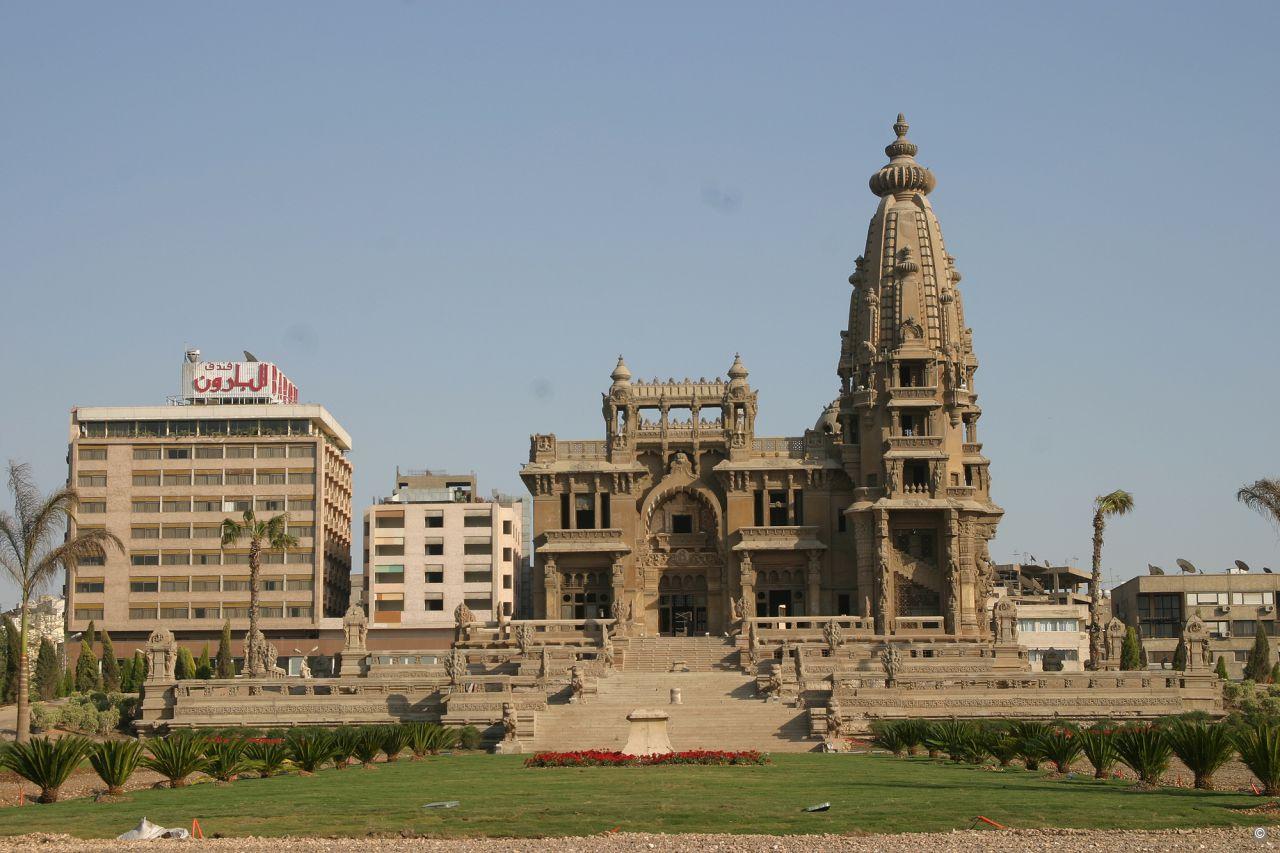
Name of Monument:
Hindu Villa
Other name of the Monument:
Baron Empain Palace; Baron Palace
Location:
Heliopolis (Cairo), Egypt
Responsible Institution:
Ministry of Antiquities; Ministry of Culture
 About Centre for Documentation of Cultural and Natural Heritage (CULTNAT), Heliopolis (Cairo)
Date of Monument:
1906–1911
Architect(s) / Master-builder(s):
Architect: Alexandre Marcel; interior designer: Georges-Louis Claude
History:
Baron Empain had a passion for stylistic architecture from different parts of the world. The earlier buildings of Heliopolis were a melange of European and Arab architecture at a time when eclecticism was booming in Europe. His Hindu palace was and is still the crown jewel of the buildings of Heliopolis. The Baron Empain Palace was built using an innovative technique called the Hennebique system – named after the French engineer François Hennebique – wherein reinforced concrete was used for the first time. The varied external elements drawn by Marcel were cast in France via the Hennebique enterprise, then transported to Cairo and assembled on-site. The villa’s interior decorations were made by the French interior designer Georges-Louis Claude (1879–1963).
Description:
The Hindu Villa of the Baron Empain (Edward Louis Joseph Empain, born on 20 September 1852 at Boleil-en-Hainaut, Belgium, died on 22 July 1929 at Waluwe-Saint-Pierre) is known today as the Baron Palace. The house was erected in 1906 following the plans of the French architect Alexandre Marcel (1860–1928), member at the Institut de France. The house reflects a mix of styles: Indian, Mongolian and Chinese, with some Islamic features. The eye-catching silhouette of the palace recalls the image of a Hindu temple. Marcel was already well-known for his exotic opera, in which he merged his masterpieces in a model titled “Panorama around the World: a Japanese Pagoda, Chinese Pavilion and an Indian Temple” that he made for the Exposition Universelle in Paris in 1900. This was Marcel’s inspiration for Empain’s residence.
Citation of this web page:
Ahmad al-Bindari "Hindu Villa" in "Sharing History", Museum With No Frontiers, 2026.
https://sharinghistory.museumwnf.org/database_item.php?id=monument;AWE;eg;1;en
Prepared by: Ahmad Al-BindariAhmad al-Bindari
19th and 20th Century Researcher and Photographer, Architecture and Urban Heritage Program - 19th and 20th Centre for Documentation of Cultural and Natural Heritage (CULTNAT), Bibliotheca Alexandrina.
Copyedited by: Daniel de la VegaDaniel de la Vega
Daniel de la Vega is a copy editor based in Portland, Oregon. He obtained his bachelor’s degree in linguistics from the University of California at Santa Cruz in 2014 and has since done editing and localization work on everything from college applications to magazines to video game dialogue.
MWNF Working Number: ET2 001