

 Close
Collections | Music, Literature, Dance and Fashion | Dance and entertainment [40 Objects, 1 Monuments]

A Scene from the Turkish Harem
Second half of the 17th century
Pera Museum
Istanbul, Türkiye
 See Database Entry
The women of the harem invite a female guest to their quarters and amuse her and themselves with dance, music, comedy and similar forms of entertainment.

An Entertainment Scene (Evening entertainment in the Golden Horn) from Surname-i Vehbi
18th century
Topkapı Palace Museum
Istanbul, Türkiye
During the classical period of the Ottoman Empire, the sultan organised public entertainment and ceremonies to mark important dates and events.

An Entertainment Scene (The third day of entertainment) from Surname-i Vehbi
18th century
Topkapı Palace Museum
Istanbul, Türkiye
Ceremonies and entertainment events at court demonstrated political prowess; public entertainments organised by the sultan helped to reduce social tension.

An Entertainment Scene (The third day of entertainment) from Surname-i Vehbi
18th century
Topkapı Palace Museum
Istanbul, Türkiye
The guilds made efforts to show off their more powerful and most surprising innovative technical discoveries according to their own professions.

Turkish woman at the hammam or baths
c. 1790
The British Museum
London, United Kingdom
Women used the hammam to socialise and chat and impromptu and organised entertainments were also provided.

Karagöz and Hacivat Shadow Play
Bursa Karagöz Museum
Bursa, Türkiye
One of the most popular entertainments of Ottoman society was the shadow play, which were frequently performed at coffee houses during Eid celebrations and at other public festivals.

19th century
Museum of Costume, Ethnographical Heritage Research Centre
Madrid, Spain
The ‘ud or lute was a popular instrument that was played at court and during public events.

19th century
Lebanese National Higher Conservatory of Music
Beirut, Lebanon
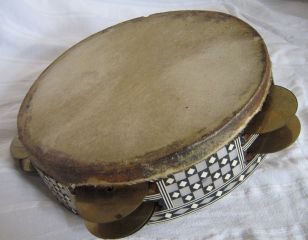
The buzuq, typically played as a solo instrument, was used in both folk and urban contexts in Syria, Lebanon, Palestine and Jordan.
19th century
Lebanese National Higher Conservatory of Music
Beirut, Lebanon
The 18th-/19th-century Romantic movement in Europe popularised the traditional dance forms of the Arab and Ottoman world. The performances were often accompanied by traditional instruments.

19th century
Lebanese National Higher Conservatory of Music
Beirut, Lebanon
During the Orientalist period, traditional Arab and Ottoman instruments, dance and musical compositions were introduced to European audiences.

19th century
Lebanese National Higher Conservatory of Music
Beirut, Lebanon
The mijwiz, which literally means “double” in Arabic, was a very popular instrument in Lebanese music and dance culture.

19th century
Weaponry Museum
Doha, Qatar
The Ardha is a traditional sword dance from Qatari folk culture, which usually begins with two rows of men who stand facing each other.

19th century
Weaponry Museum
Doha, Qatar
The Razeef is a dance performed by men and boys who hold blunt ornamental swords that they lift up and down, moving slowly around, while singing.


19th century
Ege University Museum of Ethnography
Izmir, Türkiye
In the 19th century, folk musicians played regional variations of the violin whose style was based on Western instruments.

Aladdin, or The Magnificent Lamp: sketch of the set for act 1 or act 2
1822
National Library of France
France
Replete with movements and images inspired by the “East”, “Story ballets” were particularly popular in the 19th and early 20th centuries.

Published in 1849
Sharjah Art Museum / Sharjah Museums Department
Sharjah, United Arab Emirates (Sharjah)
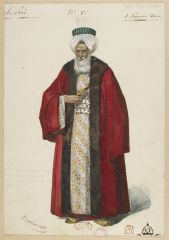
The coffee house was an important social hub in the Arab and Ottoman world that was largely populated by men. Here, patrons exchanged news, enjoyed various entertainments and smoked tobacco from pipes known as nargile.

Second half of the 19th century
Pera Museum
Istanbul, Türkiye
In the Ottoman palace the women studied music and learned to play an instrument so that they could play a part in the entertainments held in the harem.

Théâtre Impérial du Châtelet. Aladdin and the magnificent lamp; the genies of the lamp (ballet).
1863
National Library of France
France
The impact on the Parisian public of “Eastern”-inspired ballets created waves of Orientalist-inspired creations throughout the fashion and art worlds.