

 Close
Collections | Migrations | The life of European immigrant communities: Egypt and Tunisia | Social and political life [20 Objects, 2 Monuments]

19th century
Tunis, Tunisia
 See Database Entry
Built in 1897 with the goal of catering for the needs of the growing French population in Tunisia, this hospital was initially known as the Hôpital Civil Français. It superceded a smaller community hospital (Hôpital Saint Louis), founded in 1843 by François Bourgade.

19th century
Tunis, Tunisia
After World War II, the French authorities changed the name of the Italian hospital in Tunis, Ospedale Giuseppe Garibaldi, into Hospital de la Libération. After independence, it took the name of Hôpital Habib Thameur.

24 July 1856
State Archives of Livorno
Livorno, Italy
In 1845, in Cairo, Italian political exile Giacomo Castelnuovo founded the biweekly paper Spettatore Egiziano, the first Italian-language newspaper to be published in Egypt. He later also founded Il Progresso d’Egitto, a bulletin aimed at keeping the Italians in Egypt informed about Italian political news.

Lesson at the Benaki Orphanage in Alexandria Egypt
1888–1921
Benaki Museum
Athens, Greece
In Egypt, the Greeks formed the largest European community, numbering about 100,000 by the late 1920s. The Benakis – who set up this orphanage in Alexandria – were one of the most prominent and economically successful families of the Greek diaspora.
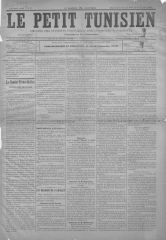
Le Petit Tunisien. Voice for French interests and communities in Tunisia.
21 July 1889
National Library of France
Paris, France
With the increasing influx of migrants into North Africa, a local press catering for their needs soon developed. This French newspaper was addressed to the different European communities living in Tunisia under the French protectorate.
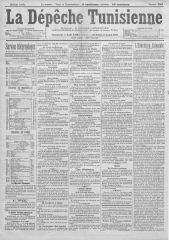
7 August 1898
National Library of France
Paris, France
La Dépêche Tunisienne was one of several French newspapers that addressed the local French community living under the Protectorate in the late 19th and early 20th centuries.

1898
State Library of Modern and Contemporary History
Rome, Italy
This booklet testifies to the presence of a significant Italian anarchist community in Tunisia at the end of the 19th century. Errico Malatesta (1853–1932) was one of the most important Italian anarchist leaders. He spent a good part of his life in exile (in Argentina, Egypt, France, Lebanon, Syria, UK, USA and other countries).

1906
Italian Geographical Society (SGI)
Rome, Italy
In 1884, in Tunis, a group of Italian traders set up the Associazione Commerciale Italiana (Italian Trading Association). In 1887, a decree by the Italian Ministry of Agriculture, Industry and Trade created the Italian Chamber of Commerce of Tunisia, with the aim of supporting Italian economic activities in Tunisia and encourage trade between Italy and Tunisia.

The Committee of Tunis for Milan Exhibition 1906
1906
Italian Geographical Society (SGI)
Rome, Italy
In this photo one can see some of the “big men” of the Italian community in Tunisia: Giuseppe Di Vittorio, Luigi Rey, Cesare Trionfo, Ugo Moreno, and a few others. International exhibitions provided them with a welcome opportunity to make their work known in Italy.
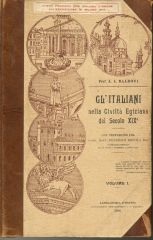
1906
Private collection
Rome, Italy
This book, intended to celebrate the role played by the Italian community in Egypt, was published on the occasion of the 1906 Milan International Exhibition, when the Italian government encouraged Italian communities abroad to make their activities known to the Italian and international public.

The stand of the Italian Community in Tunisia at the International Exhibition held in Turin in 1911
1911
State Archives of Livorno
Livorno, Italy
On the 50th anniversary of the Italian unification as a nation state, the Italian government organised different international exhibitions. In Turin, one building hosted the stands of the Italian communities abroad. Celebrating the activities of the Italian migrants was instrumental in strengthening their loyalty to their home country.

c. 1905
Italian Geographical Society (SGI)
Rome, Italy
The benevolent fund had distributed 169 pairs of shoes, 210 shirts, 269 dresses, 110 hats, 17 woolen blankets, and so forth. One can thus infer that in Tunisia, at the time, there were quite a few Italian migrants who could not afford buying basic items of clothing.

The Students’ Benevolent Fund of the Società Dante Alighieri
First years of the 20th century
Italian Geographical Society (SGI)
Rome, Italy
The Italian community in Tunisia included not only wealthy entrepreneurs, professionals and merchants, but also impoverished labourers, the unemployed and other destitute individuals. Some of the wealthy immigrants set up benevolent organisations to care for the poor members of their community.

Third-grade pupils of the Italian state-funded Giovanni Meli primary school in Tunis
First years of the 20th century
Italian Geographical Society (SGI)
Rome, Italy
In 1831, Italian political exile Pompeo Sulema and his sister Esther opened the first Italian primary school in Tunisia. By the end of the 19th century, in Tunisia the Italian state ran 11 primary schools, 5 secondary schools and 5 kindergartens (including an orphanage).

The female surgery division of the Italian hospital in Tunis
First years of the 20th century
Italian Geographical Society (SGI)
Rome, Italy
In 1890, the Italian community in Tunisia set up the first Italian hospital in a rented building. In 1900, the hospital moved to a new facility and in 1907 took the name Ospedale Giuseppe Garibaldi.
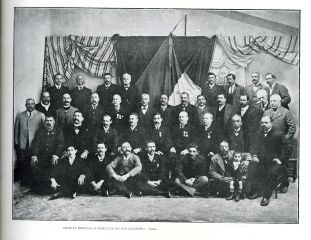
Italian Workers Friendly Society (Tunis)
First years of the 20th century
Italian Geographical Society (SGI)
Rome, Italy
Common in Italy since the mid-19th century, workers’ friendly societies soon also flourished in Tunisia and other countries of immigration. In the absence of public welfare, friendly societies helped members to cope with hardship due to illness, accident, unemployment or death. Members regularly paid a fee and received help in case of need.
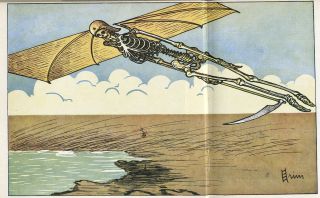
1911
State Library of Modern and Contemporary History
Rome, Italy
Italy’s war for the colonial conquest of Libya was the theatre for the first aerial bombing, although primitive. This practice was strongly criticised by Italian opponents of the war, as can be seen from this cartoon.

Receipt for a subscription among the Italians in Tunisia to buy Italy a plane
Tunis, 15 April 1912
State Archives of Livorno
Livorno, Italy
Italy’s war against Ottoman Turkey for the colonial conquest of Libya had dramatic repercussions in Tunisia. In 1911, tensions over the war flared between Italians and Tunisians, causing violent clashes.
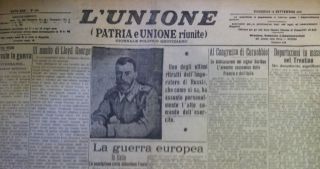
The Italian-language newspaper L’Unione (1886–1943), printed in Tunis
19 September 1915
State Library of Modern and Contemporary History
Rome, Italy
The Italian community gave a great impetus to the development of the press in Tunisia. It is thought that the very first newspaper to be published in the country was Il Giornale di Tunis e Cartagine, in 1838, thanks to the initiative of two immigrant typographers from Naples. From that date to 1956, 123 Italian language papers were published in Tunisia.

1915–18
State Archives of Livorno
Livorno, Italy
Many Italian immigrants from North Africa joined the Italian army during World War I. Over 1,200 from Tunisia alone died while serving in the military during the war.