

 Close
Collections | International Exhibitions | The official showcase of the nations | Communication and self-representation [25 Objects]

Interior of Kairouan Mosque, Tunis
1850–1892
National Archaeological Museum
Madrid, Spain
 See Database Entry
Photography was one of the most effective mediums for each country to document itself, not only in terms of artistic heritage but also to show elements of popular culture, such as costume for example. This is one of 89 photos taken by the Tunisian Antiquities Service for the European Historic Exhibition held in Madrid in 1892.

Medal – The Great Exhibition Palace, London 1851
1851
National Museum of Romanian History
Bucharest, Romania
The Crystal Palace symbolised the Great Exhibition held in London in 1851. The verso of this celebrative medal reads: “Proposed by H.R.H Prince Albert. Designed by Josh Paxton. Erected by Fox Henderson & Co. Occupies 18 acres.” The recto details the measurements of the building and the weights of the steel and glass.
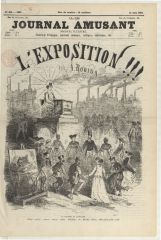
The Exhibition!! The triumph of industry
1867
National Library of France
Paris, France
This caricature pokes fun at the “universal cult” of Industry, which here is seen seated on a throne alimented with carbon, while all the people of every nationality that surround her are totally oblivious to the pollution. It seems that even works of art can now be produced by machines!

Medal of Emperor Franz Joseph I
1873
Kunsthistorisches Museum, Coin Cabinet
Vienna, Austria
The celebrative medal struck for the exhibition held in Vienna in 1873 depicts the “Rotunda” pavilion designed by Scott Russell; there is a portrait of Emperor Franz Joseph I on the obverse. The medal commemorates the 25th anniversary of the emperor’s reign and, after several military defeats, it also represents the Austrian Empire’s integrity while also celebrating the renovated city.

Gustave Eiffel. The Eiffel Tower in 1889
1889
National Library of France
Paris, France
The Eiffel Tower, depicted on a poster for the exhibition held in Paris in 1878, is seen as a symbol of France’s industrial innovation and vitality. The other images represent the Palace of Industries where the “Dôme Central” was the first building to use electricity to large extent, and the “Machine Gallery”, intended to promote modern industrial machines, had some exhibits that looked well into the technological future.

The opening of the exhibition, by Blass. M. Carnot and his entourage, pass under the Eiffel tower
1889
National Library of France
Paris, France
The iconography connected with individual International Exhibitions was sometimes employed by magazine and newspaper journalists to reveal the “hidden side” of the official narrative connected with them. In France, for example, this cartoon was published to mock good naturedly the auto-celebrative use of the 1889 exhibition which was held during a difficult political period in France.

1890
National Library of France
Paris, France

1893
Istanbul Archeological Museums
Istanbul, Türkiye
This is a memorial volume for the World’s Columbian Exposition, or Chicago World’s Fair, which was held in 1893 to celebrate the arrival of Christopher Columbus to the New World in 1492. The Ottoman Empire was invited to participate in this extremely influential social and cultural event.
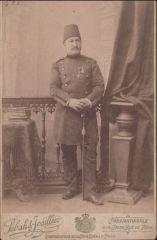
Portrait Album – Ottoman State Officers
Late 19th century – beginning of the 20th century
Istanbul University, Nadir Eserler Kütüphanesi (Rare Books Library)
Istanbul, Türkiye
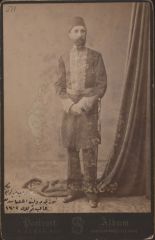
Portrait Album – Ottoman State Officers
Late 19th century – beginning of the 20th century
Istanbul University, Nadir Eserler Kütüphanesi (Rare Books Library)
Istanbul, Türkiye
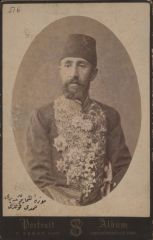
Portrait Album – Ottoman State Officers
Late 19th century – beginning of the 20th century
Istanbul University, Nadir Eserler Kütüphanesi (Rare Books Library)
Istanbul, Türkiye
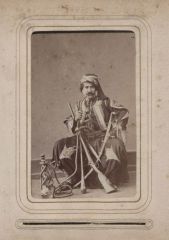
Pascal Sebah, a pioneering photographer working in Istanbul, prepared The Ottoman Clothing Album as an exhibit on the Ottoman stand at the exhibition held in Vienna in 1873. Through modern photographic technology, Ottoman Turkey proposed to occidental visitors a series of “realistic” male and female portraits to provide a powerful image of Ottoman culture.
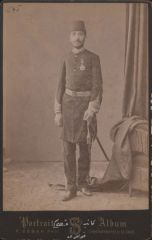
Portrait Album – Ottoman State Officers
Late 19th century – beginning of the 20th century
Istanbul University, Nadir Eserler Kütüphanesi (Rare Books Library)
Istanbul, Türkiye
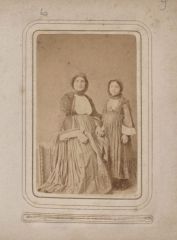
Late 19th century – beginning of the 20th century
Istanbul University, Nadir Eserler Kütüphanesi (Rare Books Library)
Istanbul, Türkiye
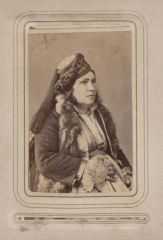
Late 19th century – beginning of the 20th century
Istanbul University, Nadir Eserler Kütüphanesi (Rare Books Library)
Istanbul, Türkiye
Pascal Sebah, a pioneering photographer working in Istanbul, prepared The Ottoman Clothing Album as an exhibit on the Ottoman stand at the exhibition held in Vienna in 1873. Through modern photographic technology, Ottoman Turkey proposed to occidental visitors a series of “realistic” male and female portraits to provide a powerful image of Ottoman culture.
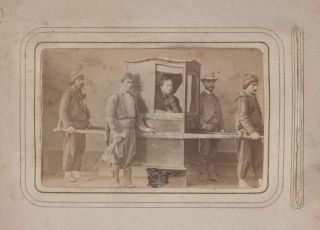
Late 19th century – beginning of the 20th century
Istanbul University, Nadir Eserler Kütüphanesi (Rare Books Library)
Istanbul, Türkiye
Late 19th century – beginning of the 20th century
Istanbul University, Nadir Eserler Kütüphanesi (Rare Books Library)
Istanbul, Türkiye
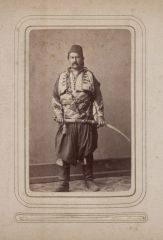
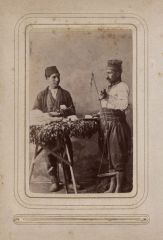
Pascal Sebah, a pioneering photographer working in Istanbul, prepared The Ottoman Clothing Album as an exhibit on the Ottoman stand at the exhibition held in Vienna in 1873. Through modern photographic technology, Ottoman Turkey proposed to occidental visitors a series of “realistic” male and female portraits to provide a powerful image of Ottoman culture.
Late 19th century – beginning of the 20th century
Istanbul University, Nadir Eserler Kütüphanesi (Rare Books Library)
Istanbul, Türkiye
Late 19th century – beginning of the 20th century
Istanbul University, Nadir Eserler Kütüphanesi (Rare Books Library)
Istanbul, Türkiye
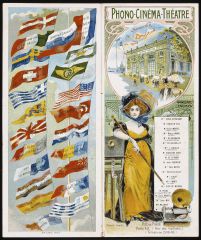
Programme card for the Exposition Universelle of 1900. Phono-Cinéma-Théâtre
1900
National Library of France
Paris, France
The invention of Phono-Cinéma-Théatre made the dual-projection of sound and images possible for the first time. Thanks to a phonograph, Henri Lioret and Clément-Maurice Gratioulet were able to synchronise the voices of famous actors of the time (e.g. Sarah Bernhardt) with the images.
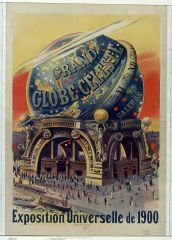
The great celestial globe. 1900 Exposition Universelle.
1900
National Library of France
Paris, France
The Grand Globe Céleste, situated on the Champ de Mars, became a dominant symbol of the Paris exhibition of 1900. Created to represent France’s progress in scientific research, inside the 50-metre diameter sphere, visitors could discover astronomy. Apart from the huge dimensions of the globe, the poster also illustrates the affluence of the viewing public.