

 Close
Collections | International Exhibitions | The official showcase of the nations | Representation of the “other” [8 Objects]

1878
National Central Library
Roma, Public domain
 See Database Entry
This image looks almost like a snap-shot of the inside of one of the “Oriental” pavilions at the exhibition held in Paris in 1878. The faces of the visitors seem to express their curiosity and fear as they inspect the young salesman and his wares: both appear so “different” from anything they’re used to seeing.

Algerian Shoemaker at the Trocadéro [Paris Exhibition, 1878]
1878
National Central Library
Rome, Italy
The catalogue for the exhibition held in Paris in 1878 describes in detail the work of the artisans who were “exhibited” in the “Oriental Bazaar” next to the Trocadéro Park. Seen here is a member of the Kabyle people, traditionally slipper-makers, from the province of Constantine. The report is not free from the usual generalised statements and the inevitable comparison with occidental costume.

'Ethnographic Exhibition' [Paris Exhibition, 1878]
1878
National Central Library of Rome
Rome, Italy
At the Paris exhibition of 1878, Colonel le Clerc’s so-called Ethnographic Exhibition was organised in three rooms, in which 72 human “types” from around the world were represented, dressed-up and armed as warriors. A great deal of attention was paid to rendering the face and physical appearance generally; le Clerc wanted to assimilate the “theoretical” with the picturesque.
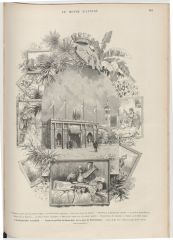
Exposition in Algiers - façade of the Pavillon des Beaux-Arts, in the Place du Gouvernement
1880
National Library of France
Paris, France
The first “Algerian” exhibition held in Paris in 1889 was France’s opportunity to promote the benefits of colonisation. The paintings exhibited there demonstrated that the colonisers were totally estranged from the local culture. This can be seen on the left, in the Mauresque jouant avec son enfant (Moor playing with her child) by Émile Charles Labbé, which is a singular reassessment, in the Orientalist style, of the famous Madonna del velo by Raphael.

Oussman Gassi, King of Bundu, 42 years, born in Sendou
1889
National Library of France
Paris, France
This series of 41 anthropological photographs was presented at the exhibition held in Paris in 1889. The photographic medium was used in order to satisfy the public’s curiosity about African and Asian peoples, but their curiosity was fuelled by exhibitions and studies that at the time were considered “scientific”.
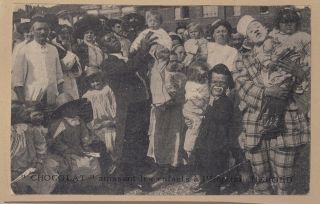
[The clown] 'Chocolat' entertaining children at the hospital
late 19th century
National Library of France
Paris, France

Postcard: Colonial Exhibition 1907, Tuareg caravan
1907
National Museum of Anthropology
Madrid, Spain
This postcard shows five Tuareg tribesmen on camels at the 1907 Colonial Exhibition held in Paris. Since the second half of the 19th century, men, women and sometimes even children of the former colonies were used as “exhibits” at the International Exhibitions, reflecting the popularity of the new disciplines of anthropology and ethnology.
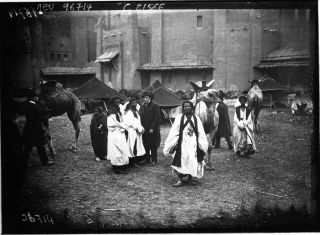
1922
National Library of France
Paris, France
France celebrated her colonies at the Expositions Universelles held in Paris and at the Colonial Expositions held in Marseille (1906, 1922) and in Paris (1931). These “indigenes villages” that to the 21st-century eye are so distasteful, at the time, responded to the European imagination concerning the colonies, and also offered France an easy means to promote exotic scenarios and display its power.