

 Close
Collections | Economy and Trade | Important trading hubs | Trading communities [24 Objects]

1757–1810
Benaki Museum
Athens, Greece
 See Database Entry
In the 19th and early 20th centuries, Smyrna (modern Izmir) was a cosmopolitan city in which a high percentage of non-Muslim communities lived and worked peacefully alongside their Muslim neighbours. Many inhabitants were Greeks, influential in economic as well as cultural and intellectual life.

Portrait of Abraham Behor And Nisim Camondo
The Quincentennial Foundation Museum, Zulfaris Synagogue Museum
Istanbul, Türkiye
Abraham Behor (1829–89) and Nisim Camondo (1892–1917), the grandsons of Abraham Salomon de Camondo, looked after the Camondo business interests in Paris after their families left Istanbul in 1869. Their descendants were to become important supporters and benefactors of the arts.

19th century
Institut Culturel Italien (Italian Emabassy in Tunisia)
Tunis, Tunisia
Marius Scalesi was a poet born in Tunis in 1892 to parents of Italian-Maltese descent. A fascinating personality due to his complex, multifaceted identity, Scalesi is today considered one of the pioneers of North African poetry written in French.
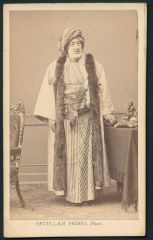
Portrait of Abraham Salamon De Camondo
19th century
The Quincentennial Foundation Museum, Zulfaris Synagogue Museum
Istanbul, Türkiye
Jews from many different geographic backgrounds formed an active and influential part of Istanbul’s urban population over many centuries. In the 19th century, Jewish financiers and merchants such as Abraham Salomon de Camondo (1781–1873), the patriarch of the mercantile Camondo family, worked closely with the Ottoman government and their communities, establishing workshops and schools such as the Camondo Institute.
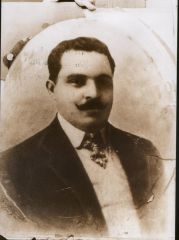
19th century
The Quincentennial Foundation Museum, Archive of Turkish Jews
Istanbul, Türkiye
Binjamin Uziyel belonged to one of the influential Jewish families in Istanbul involved in finance, commerce, philanthropy and, indeed, politics.
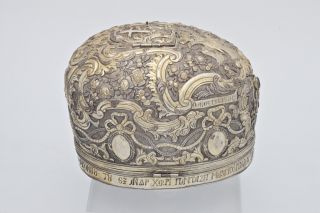
Reliquary of St-George Chiopolites from Aivali
1816
Benaki Museum
Athens, Greece
Over centuries, Greeks were among the most widely dispersed, economically successful and best-integrated trading communities active throughout the Mediterranean region, the Near East and many parts of Europe. Wherever they settled, they combined a cosmopolitan lifestyle with a firm commitment to upholding their orthodox faith and communal traditions.
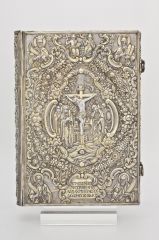
Gospel cover of Dorotheos Proios from Edirne
1816
Benaki Museum
Athens, Greece
In the 19th and early 20th centuries, Smyrna (modern Izmir) was a cosmopolitan city in which a high percentage of non-Muslim communities lived and worked peacefully alongside their Muslim neighbours. Many of the best silversmiths active in the city were Greeks and Armenians.
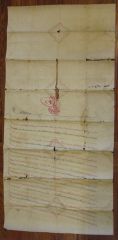
Hegira 1234 / AD 1819
Benaki Museum
Athens, Greece
Many non-Muslim Ottomans – Greeks, Armenians and Jews among them – worked as translators and employees of European merchants active in Middle Eastern ports and cities. This firman with the tughra (imperial monogram) of Sultan Mahmud II dated August/September 1819 legislates for such employees in Smyrna.

Tunis, 2 November 1846
State Archives of Florence
Florence, Italy
Southern European Jews had settled in many North African cities by the 19th century. This treaty asserts Tuscan jurisdiction and protection for Tuscan Jews in Tunisia. Many European powers insisted on similar treaties for religious minorities resident in Muslim lands both to ensure their safety and as covert opportunities to interfere in a country’s internal affairs.

Constantinople, 9 August 1848
State Archives of Livorno
Livorno, Italy

Cairo: houses and gardens in the French quarter. Flaubert in the foreground
1852
National Library of France
Paris, France
In 19th-century Cairo, European communities tended to live in the ‘Quarter of the Franks’ (harat al franj). At its heart lay a market and several European-style, glass-fronted shops owned by members of the various foreign communities resident in the city.

Hüdavendigar Paper in Armenian
1869
Bursa Basın Tarihi Müzesi
Bursa, Türkiye
For centuries, Armenian communities played an important economic part in societies around the Mediterranean. In Istanbul, they were among the most influential and integrated commercial communities.

1870–74 (the Tunisian decoration); 1884–1906 (the Italian decoration)
State Archives of Livorno
Livorno, Italy
Successful members of Jewish commercial communities, such as Raffaello Moreno and his brother Leon – whose family originated from Livorno – were often acknowledged by both their native and resident countries, a fact represented here by this Tunisian-Italian decoration.

The European neighbourhood of Tunis and the Northern Suburbs
1875
Italian Geographical Society (SGI)
Rome, Italy
19th-century Tunis attracted many economic immigrants, particularly from France, the Italian islands and Malta. By the early 1900s, Tunis was home to huge French and Italian colonies, with half of its population foreign.
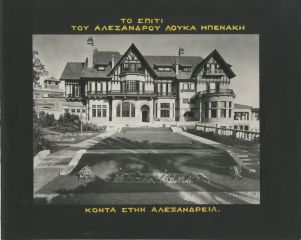
The Mansion of Alexandros Lukas Benakis in Alexandria
1888–1920
Benaki Museum
Athens, Greece
The commercial elite, whether local or foreign, played an active part in the political, social and cultural life of the cities they had settled in. From his residence in Alexandria, A.L. Benaki, for example, oversaw many important philanthropic projects for the benefit of the city’s community at large.

Family gathering in Alexandria
1889
Benaki Museum
Athens, Greece
Greeks always played an important part in the economy of Egypt, be it as wealthy entrepreneurs based in Alexandria and Cairo or as small shop owners and financiers making a living in the countryside. Rather than living in foreign enclaves, many preferred to settle right at the heart of their host communities.
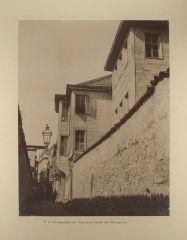
Narrow street in Pera, Istanbul
1893
Benaki Museum
Athens, Greece
Pera (also known as Galata) lies on Istanbul’s European side. Traditionally it was home to foreign merchants and European embassies. In the 19th century, it became Istanbul’s most Westernised area, with its diverse foreign communities opening modern schools, shops and cultural venues.

Villa Maria, in Tunis, the mansion of Luigi Rey, the son of a migrant from Piedmont (Italy)
Photograph: first years of the 20th century; building: late 19th century
Italian Geographical Society (SGI)
Rome, Italy

1900
Jordan Museum for Costumes and Jewellery, Department of Antiquities
Amman, Jordan

Early 20th century
Jordan Folklore Museum, Department of Antiquities
Amman, Jordan