

 Close
Collections | Economy and Trade | Commodities [92 Objects, 3 Monuments]

Jordan Museum for Costumes and Jewellery, Department of Antiquities
Amman, Jordan
 See Database Entry
The drinking of coffee, discovered by the Arabs, was introduced in the 16th century in the Ottoman Empire, from where it spread to Europe. Until the 18th century, Yemen held the monopoly on coffee production and exports. But it lost this pre-eminence after European powers started to grow coffee in their West Indian and American colonies and became by the 19th century the main coffee exporters into Europe, the Middle East and North Africa.

19th century
Musée Public National des Arts et Traditions Populaires
Algiers, Algeria
In the 19th century, gold thread, which was used in adorning traditional garments, was imported by Algeria from Europe, especially from Lyon.

19th century
Musée Public National des Antiquités
Algiers, Algeria

19th century
Lebanese Heritage Museum
`Ayn Najm, Lebanon
Oriental water pipes called huqqas (from Persian for “coconut” because they used to be made from coconut shells) or narghiless (in Turkish) are thought to have originated in India, from where they spread to Iran and reached the Ottoman Empire in the 17th century. They later became popular in the Balkans too.

19th century
Ethnographic Museum
Fez, Morocco
For the manufacturing of swords, blades were imported in 19th-century Morocco from Syria, but also from Toledo, where blades whose steel was considered comparable in quality to Damascus steel were produced by the Royal Manufactory built in 1780 outside the city in the valley of the river Tagus.


19th century
National Museum of Qatar
Doha, Qatar
Dhows, traditional wooden Arabian sailing vessels, could be of various types. Those generally used for pearl fishing were called sambuk.

19th century
Musée des Arts et Traditions Populaires
Tunis, Tunisia
Apart from the garments and cloths it imported from Western Europe, Tunisia also purchased gold and silver threads, as well as articles of passementerie, which were used in the ornamentation of traditional clothes.

19th century
Musée d’Histoire Moderne et Contemporaine de Kassar Saïd
Le Bardo, Tunis, Tunisia
In the 19th century, members of the Moroccan upper classes purchased items of furniture made in Western Europe. Italian producers were among the most appreciated.

19th century
Private collection
Tunis, Tunisia
Gold and silk threads were imported by Tunisia, as well as by Algeria, mostly from Lyon, a French city famous for its production of textile gildings (dorures) and articles of passementerie until the 1920s.

19th century
Palais de la Rose – Musée de l’Armée
La Manouba, Tunis, Tunisia
In the late 19th century, as Moroccan Sultan Hasan I took measures to increase the military capacity of his sultanate, he also deemed it necessary to modernise the army’s weaponry. Firearms and artillery were therefore purchased from Western Europe, mostly from the UK and France, but from other countries too.

Café du Marabout in the Souk Ettrouk
Early 19th century
Institut Supérieur d’Histoire Contemporaine de la Tunisie
La Manouba, Tunis, Tunisia
In North Africa, as in the Middle East, coffee was imported in the 19th century from European colonies in the West Indies. According to Thomas MacGill, a Scottish merchant who visited Tunisia in 1811, by then Tunisians were already using much more coffee from Martinique, one of France’s West Indian colonies, than from Yemen.

Decanter (one of a set of three)
Hegira 13th century / AD 19th century
Shangri La, Doris Duke Foundation for Islamic Art
Honolulu, Hawai'i, United States of America
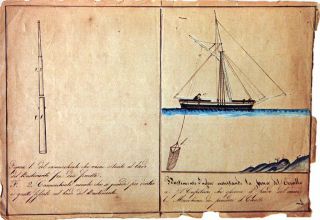
A British Ship Coral Fishing Near Algiers
26 October 1826
State Archives of Naples
Naples, Italy
Ever since the 16th century, the Regency of Algiers licensed the rights for fishing coral in its coastal waters to French companies. After the French Revolution of 1789, France decided to give up its monopoly over coral fishing in Algeria and so fishing rights also began to be granted to other Europeans, such as the British and the Italians.

Café and fountain behind the Fort-l’Empereur
1832
Musée Public National des Antiquités
Algiers, Algeria
After Algeria became a French colony, most of its coffee was imported from the West Indian colonies of France, whose commercial vessels paid lower custom duties than vessels from other countries for coffee shipments.

3 March 1832
State Archives of Livorno
Livorno, Italy
Two years after the conquest of Algiers (1830), the French authorities established a set of rules for coral fishing in Algeria. Foreign companies were accepted but had to pay fees for fishing coral, while French boats were exempt from any taxes.

1841
Btater, al-Shuf, Lebanon
Silk became in the 19th century the main agricultural produce of Mount Lebanon, most of it being exported to France. In 1841, three French entrepreneurs – Nicolas, Joseph and Antoine Fortuné Portalis – founded the first silk factory in Mount Lebanon, which was built in Btater, and European spinners were brought to teach the locals the European method of spinning silk threads.


Hegira c. 1255 / AD 1840
Shangri La, Doris Duke Foundation for Islamic Art
Honolulu, Hawai'i, United States of America