

 Close
Collections | Fine and Applied Arts | The concept of revivals | Designers [17 Objects, 2 Monuments]

19th–20th centuries
Sidi Bou Saïd, Tunisia
 See Database Entry
One of the most significant influences of Orientalism was in architecture, with the design of houses with courtyards, gardens and fountains, such as this palace built by Baron Rodolphe d’Erlanger in Sidi Bou Said, Tunisia, between 1911 and 1912. Both the structure and decoration are based particularly on the local Tunisian, al-Andalus (Andalusian) and Arab traditions, which is evident in the tiles, stucco work and painted and gilded wood.

Details and ornaments from the Alhambra by Owen Jones, Architect
1845
National Museum of Decorative Arts
Madrid, Spain
Between 1836 and 1845 the British artist and designer Owen Jones published 12 volumes entitled Plans, Elevations, Sections and Details of the Alhambra. Jones’ work, with its numerous precise architectural drawings and detailed speculations regarding the Alhambra’s original colour scheme, exerted a revolutionary influence on European artists of his time.

2nd half of the 19th century
Cerralbo Museum
Madrid, Spain
The fascination for the Alhambra was such that small plaques of painted plaster reproducing parts of the palace began to be produced. One of the most important workshops belonged to Rafael Contreras, who was a conservator/decorator at the Alhambra. These types of copies were very popular and were used by architects and designers as inspiration for the decoration of so-called Moorish smoking rooms.
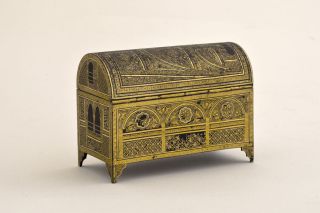
c. 1860
National Museum of Decorative Arts
Madrid, Spain
The influence of Islamic decorative techniques on metal such as damascening, led Plácido Zuloaga to develop this technique and apply it to the decorative arts with great success. His work won awards at World Fairs. Damascening, which is a term derived from the name of the city of Damascus, was a very widely used technique in Islamic art.
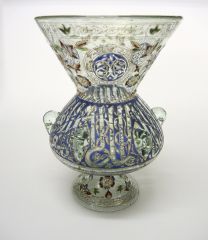
1867
MAK – Austrian Museum of Applied Arts / Contemporary Art
Vienna, Austria
Philippe-Joseph Brocard was a restorer and collector of antiques. He admired examples of Mamluk glass at the Musée de Cluny in Paris and then acquired some pieces himself, which he used as models of inspiration. Among the first to revive Islamic enamelling techniques, Brocard’s work was exhibited in the Paris Exposition of 1867, thus making this piece one his earliest documented pieces.
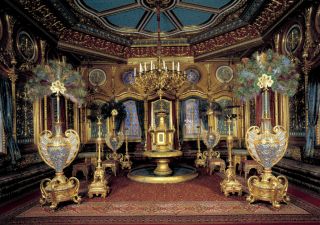
The King's House on the Schachen
1869–1872
Bavarian Alps near Garmisch-Partenkirchen; altitude 1,866 meters, Germany
Publications regarding the Alhambra Palace in Granada and the decorative motifs found in Islamic and Ottoman art had an influence on interior decoration, such as in the “Turkish Hall” of the King’s House, designed by Georg von Dollmann (1830–95), and built between 1869 and 1872 in Schachen Alp near Garmisch-Partenkirchen. This hall is richly decorated in the Orientalist style.
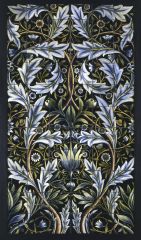
1876
Victoria and Albert Museum
London, United Kingdom
William Morris was founder of the Art and Crafts movement. This tile panel, which he made jointly with another English designer William de Morgan, was part of the bathroom decoration of an English mansion Membland Hall in Devon. The use of decorated tiles shows the extent to which Islamic and Ottoman art, with İznik productions, influenced European designs.
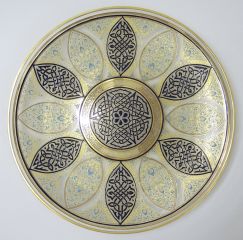
1878
MAK – Austrian Museum of Applied Arts / Contemporary Art
Vienna, Austria
Josef Lobmeyr (1792–1855) founded a glass factory that, during the second half of the 19th century, was run by his sons Josef and Ludwig. One of the styles of decoration they adopted was inspired by Orientalism and the revival of Islamic designs. Here both the technique of painting with enamel and the design are inspired by Mamluk art, which would have been highly fashionable at that time.
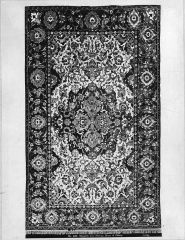
Persian carpet from Haas & Söhne
Photograph from the World Trade Exhibition 1873 in Vienna
MAK – Austrian Museum of Applied Arts / Contemporary Art
Vienna, Austria
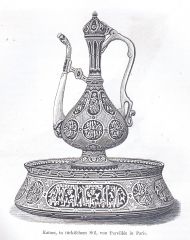
Photograph from the World Trade Exhibition 1873 in Vienna
MAK – Austrian Museum of Applied Arts / Contemporary Art
Vienna, Austria
At World Fairs, each country was represented by the most important exhibits from their country. The antique and modern pieces exhibited were published in catalogues, as in this case, which reviewed the decorative arts on show, many of which were influenced by mediaeval Islamic art.
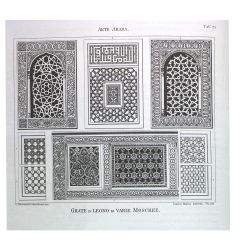
A drawing showing wooden gratings from various mosques
1878
National Central Library
Rome, Italy
This book Dell’ornamento nell’architettura, by Alfredo Melani, a teacher at the Milan School of Applied Arts and scholar of Islamic and Oriental art in Italy, demonstrates the importance of schools of applied art, set up in the 19th century, and museums of decorative arts in the development of design and styles such as the Moorish style.

One Thousand and One Nights: decorative sketch of the palace gardens. Façade of an
1881
National Library of France
Paris, France
The translation of One Thousand and One Nights, a mediaeval collection of tales in Arabic, had a significant impact in 19th-century Europe. Its influence reached the decorative arts, theatre, ballet and literature. Plays based on the tales saw theatres decorated as if they were Oriental palaces, for example the Châtelet Theatre in Paris.
1888-1897
Victoria and Albert Museum
London, United Kingdom
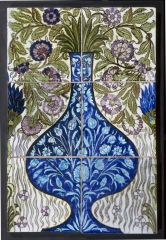
The English designer and ceramicist William de Morgan produced large tile panels that demonstrated his interest in Islamic tiles. At the end of the 19th century, Islamic ceramics were generally referred to as Persian, on account of the limited knowledge of them.
1890
National Library of France
Paris, France
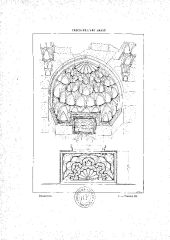
In the 19th century, artists and architects often accompanied archaeological, military or diplomatic expeditions to the Arab and Ottoman world. This was the case of the architect Jules Bourgoin, who travelled to Egypt on many occasions and produced and published a large number of drawings of Egyptian monuments and Arab architecture.

1900–1930
National Museum of Decorative Arts
Madrid, Spain
Orientalism influenced all art forms, including music and ballet. The composition of ballets such as Scheherazade, narrator of the One Thousand and One Nights, had an influence on the costumes used in ballet, such as the Russian ballets of Sergéi Diágilev. The influence, as a synonym of the exotic, even reached advertising, as seen in this example of a Spanish advert for perfume.

c. 1900 – c. 1940
Museum of Costume, Ethnographical Heritage Research Centre
Madrid, Spain
Mariano Fortuny (1871–1949) was very familiar with antique fabrics, and his research led him to design cloth influenced by antique Islamic fabrics and velvet. The designer used fine materials such as silk and metal thread to evoke the richness of mediaeval fabrics. His fabrics enjoyed great success and were used in some of his fashion designs.

c. 1900 – c. 1940
Museum of Costume, Ethnographical Heritage Research Centre
Madrid, Spain
The fabrics designed by Mariano Fortuny may have been made of cotton (as in this case) stencilled in silver, instead of being woven. This was an important technical innovation. The decorative motifs on the fabrics are based on antique Islamic, Ottoman and Italian fabrics from the designer’s collection.

c. 1914 – c. 1930
Museum of Costume, Ethnographical Heritage Research Centre
Madrid, Spain
Mariano Fortuny (1871–1949) was an important artist and designer. Known for his fabric and fashion designs, one of his sources of inspiration was the large collection of antique fabrics belonging to his mother, Cecilia Madrazo. His creations, inspired by Greek, Arabic and Ottoman pieces, were admired, and purchased by high society in Europe and America.
Paris: F.L. Schmied, 1926
Calouste Gulbenkian Museum
Lisbon, Portugal
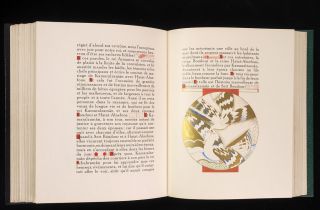
The influence of One Thousand and One Nights led to the publication of an illustrated version of these tales, such as the Histoire de la Princess Boudour, with drawings by the illustrator François-Louis Schmied (1873–1941) and Jean Dunand (1877–1942). This limited edition of 25 books demonstrates how the influence of Orientalism reached beyond the 1920s.