

 Close
Collections | Fine and Applied Arts | Encountering the East | Painting: Landscapes [19 Objects]

East View of the City of Algiers
1 May 1815
Musée Public National des Antiquités
Algiers, Algeria
 See Database Entry
The first landscapes of the Arab and Ottoman world depicted by Europeans were engravings, but these related more to geographical descriptions of cities, ports and harbours than they did to landscape views. These three engravings show different views of Algiers.

The City of Algiers from the Sea
1 May 1815
Musée Public National des Antiquités
Algiers, Algeria
The first landscapes of the Arab and Ottoman world depicted by Europeans were engravings, but these related more to geographical descriptions of cities, ports and harbours than they did to landscape views. These three engravings show different views of Algiers.

Country West of Algiers from the British Consul General's Garden
1 May 1815
Musée Public National des Antiquités
Algiers, Algeria
The first landscapes of the Arab and Ottoman world depicted by Europeans were engravings, but these related more to geographical descriptions of cities, ports and harbours than they did to landscape views. These three engravings show different views of Algiers.

The View of the City of Algiers
(published in) 1830
Musée National des Beaux-Arts
Algiers, Algeria
This view of the city and harbour was painted by Charles Rumker when he was serving with the British Navy on HMS Albion. The travels of artists and amateurs produced many paintings and sketches of landscapes from the Arab and Ottoman world.

The gardens of the Dey's palace
1832
Musée Public National des Antiquités
Algiers, Algeria
This illustration is from a book entitled Voyage Pittoresque dans la régence d’Alger. The publication was part of the French colonial campaign to discover new territory.

Jaffa from the Camp of Ibrahim Pasha
c. 1830–1833
National Museum of Romanticism
Madrid, Spain
The print shows Ibrahim Pasha’s camp at Jaffa during the Egyptian–Ottoman War (1830–33). This engraving was printed for the review Panorama Universal. The engravings and illustrations published in books, newspapers and reviews greatly influenced the development of Orientalist painting.

Oriental Landscape with Classical Ruins
1842
National Museum of Romanticism
Madrid, Spain
The Spanish artist who painted this landscape had never travelled to Egypt, but he knew what the landscape looked like thanks to the various publications that were widely available. It is important to note that in most of these landscapes the artist mixes different views, including ancient remains from Egyptian, Greek or Roman temples, or his own inventions based on a variety of engravings.

Interior of the Great Temple at Baalbec
Printed 1836–1838
Sharjah Art Museum / Sharjah Museums Authority
Sharjah, United Arab Emirates (Sharjah)
One subject often tackled in Orientalist painting is the depiction of ancient remains. The interior of the Temple of Bacchus at Baalbek, Lebanon, seen here, formed part of the book entitled Syria, The Holy Land, Asia Minor, &c, which was illustrated with views and plans. The architectural and artistic details recorded in this publication subsequently inspired European architects and artists.

Second half of the 19th century
Pera Museum
Istanbul, Türkiye
The artist has incorporated the changing light of the sun in this depiction of the shores of the Bosphorus in Istanbul. Although the work resembles a sketch with its relatively small size and unfinished look, it is a good example of the importance of the treatment of light in Orientalist paintings.

Caiques and Sailboats at the Bosporus
Second half of the 19th century
Pera Museum
Istanbul, Türkiye
The artist has incorporated the changing light of the sun in this depiction of the shores of the Bosphorus in Istanbul.

Second half of the 19th century
Pera Museum
Istanbul, Türkiye
In this view of Istanbul, French painter Félix Ziem attempts to depict the “real” city and picturesque aspects of life at sea against the backdrop of the city’s silhouette. The use of vibrant colours and the artist’s efforts to capture the constant change of light are two features common in Orientalist paintings.

A landscape from Eyüp, Istanbul
1859
Mimar Sinan Fine Arts University, Painting and Sculpture Museum
Istanbul, Türkiye
The Maltese (British) artist Amedeo Preziosi, like many of his contemporaries, had been lured to the city of Istanbul for its alleged exoticism. But in his paintings, Preziosi also tried to reflect the cultural diversity of the city. In his watercolours in particular the artist seems to express his admiration for the blue water of the Bosphorus, which he depicts populated by caïques, pavilions and palaces, boats, mansions, residences, bazaars and cemeteries.
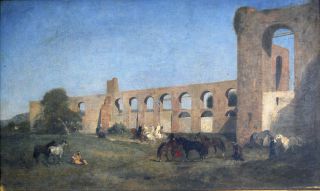
19th cenutry (c. 1858)
Musée National des Beaux-Arts
Algiers, Algeria
Views of ancient buildings and remains were often the subject of Orientalist paintings. This view of the Roman Aqueduct of Cherchell, in Algeria, was painted by the French artist Eugène Fromentin. One of the earliest European painters to travel to Algeria, and quite young when he arrived, the country’s landscape and people were subjects that inspired most of his work.

c. 1863
National Museum of Romanticism
Madrid, Spain
The Spanish painter Franciso Lameyer travelled to many different parts of the world: Morocco, Egypt, China, Japan and the Philippines. This painting was made in around 1863 when Lameyer travelled to Morocco with the artist Mariano Fortuny. The reason for their journey was to paint the “picturesque” garments and way of life of the people of Morocco.

1883
National Museum of Romanticism
Madrid, Spain
The Spanish naturalist painter Carlos de Haes never travelled to Egypt, but he depicted this Egyptian landscape thanks to engravings and photographs of Egypt that were published and sold widely. De Haes is one of Spain’s most important landscape painters who, in 1857, became the first professor of landscape painting and the first to teach painting directly from nature.

1889
National Gallery of Modern Art (GNAM)
Rome, Italy
In 1870, Cesare Biseo was working in Egypt decorating the first Cairo Opera House; in 1877, he took part in the Italian diplomatic delegation to Morocco. This painting shows an exotic Verismo, drawing on themes from real life and emphasising naturalist elements, both sentiments on which the Orientalist artists relied too due to increasing Italian interests in North Africa.

1896
Musée National des Beaux-Arts
Algiers, Algeria
Émile Henri Bernard is linked to several European avant-garde movements at the end of the 19th century, such as Impressionism and Symbolism. In 1893, while travelling to Egypt, Spain and Italy he painted this view of Cairo. While his treatment of the view may be said to relate directly to the avant-garde movement, his inspiration is Orientalist.

Courtyard of Justice at the Alhambra Palace, Granada
1909–1910
Sorolla Museum
Madrid, Spain
Sorolla depicted the Alhambra Palace many times. In this painting he focuses on the doorway to the Golden Room from the palace courtyard. With an interest in architecture, but especially in Arab gardens, the artist concentrates on the play of light on the water in the pools and not so much on other topics.

Comares Courtyard at the Alhambra
1917
Sorolla Museum
Madrid, Spain
The Alhambra Palace fascinated travellers to Spain during the 19th century. Sorolla was first struck by the Alhambra in 1902; during successive trips to Granada in 1909, 1910 and 1917, he depicted many different views of it. In this view of the Patio de Comares, the artist highlights the reflection of the arches over the pond and pays particular attention to the treatment of light.