

 Close
Collections | Travelling | Tourism | Travelling equipment [24 Objects]

Astronomical instrument: Qiblanuma
Hegira 1151 / AD 1738–9
Museum of Turkish and Islamic Arts
Sultanahmet, Istanbul, Türkiye
 See Database Entry
Foreign travellers as well as those living in the region relied on navigational skills, whether by observing the movement of the stars or using instruments like this qibla compass. This particular instrument is designed to help pilgrims find their way to Mecca from a wide range of start points.

1780
Kunsthistorisches Museum, Coin Cabinet
Vienna, Austria
An essential prerequisite for the 19th-century traveller was access to sufficient funds throughout the trip. Those on the road could be confident that the Maria Theresia Taler was widely accepted everywhere.

19th century
Weaponry Museum
Doha, Qatar
When travelling in the Middle East and North Africa, a friendly reception was not always guaranteed as robbers might be lurking along the wayside in remote areas or wild animals might attack the camp at night. As a result, weapons were an essential part of the traveller’s equipment. Ironically though, on occasion, safe passage was guaranteed by gifting or handing over the weapons to the perpetrators.

Silverware used on the Orient Express
19th century
Istanbul Railway Museum
Istanbul, Türkiye
Wealthy Europeans insisted on travelling in style and comfort wherever they went. Silver tableware sets such as this one, together with fine china, crystal glassware, tablecloths, carpets and even furniture, often accompanied a party and would be set up every day, even in a tent, while navigating the desert.

Dala’il al-Khayrat (Guidelines to Blessings) by Abu Abdallah Muhammad ibn Sulayman al-Jazuli)
Hegira 13th century / AD 19th century
Sharjah Museum of Islamic Civilisation /Sharjah Museums Authority
Sharjah, United Arab Emirates (Sharjah)
Muslim travellers and pilgrims, particularly when journeying to the Holy sites of Mecca and Medina, might carry some instructive reading with them. The Dala’il al Khairat was a popular book of prayer that also prepares the reader spiritually and practically for visiting Islam’s most sacred locations.

Description de L'Egypte: Antiquités Planches
1809–1829
Istanbul Archaeological Museums
Istanbul, Türkiye
Scholars, scientists, archaeologists, explorers, adventurers and tourists all tended to write detailed diaries, logbooks and travelogues while journeying to the Ottoman Empire and North Africa. Publications such as this one about Egypt soon led to a European craze for travelling, inspiring many to set out and see the marvels described for themselves and often accompanied by the books that had inspired them.

1819
Istanbul Archaeological Museums
Istanbul, Türkiye
A wealth of ancient sites and locations sacred to Christianity meant that the Levant held a particular fascination for Europeans. Publications like this book enabled them to plan their travels and prepare for the challenges that the journey might hold.
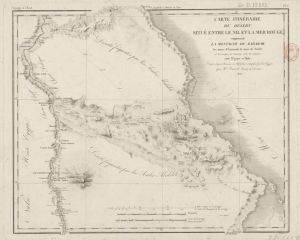
1820
National Library of France
Paris, France
Crossing the desert held a fascination for many European travellers and explorers. Increasingly, the paths that they followed – led by indigenous guides without whom they would have been lost – were recorded in detailed maps for the benefit of all those who would follow.
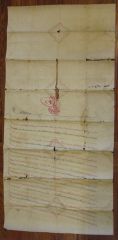
Hegira 1234 / AD 1819
Benaki Museum
Athens, Greece
Few Europeans were capable of navigating the region entirely alone, and relied on the support of local expertise. First and foremost was the need for local translators or dragomans, who, as they were often versed in several languages as well as cultural diplomacy, were able to negotiate or mediate on behalf of the traveller throughout the journey.

Constantinople et le Bosphore de Thrace
1841
Istanbul Archaeological Museums
Istanbul, Türkiye
Perhaps the most important port of call for Europeans was Constantinople. Countless travelogues about the city were published written by British, French, German and other early tourists. These combined some useful factual information along with a healthy degree of Orientalist fantasy.
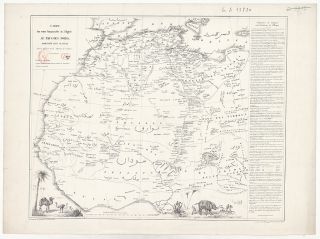
Map of Algeria's commercial routes to the 'Pays des Noirs' [Guinea]
1850
National Library of France
Paris, France
It is probably fair to say that the complex networks of arteries crossing the region developed first and foremost for the purposes of trade. By the 19th century, modern road networks improved the conveyance of goods and made travel easier and quicker for those who wanted to discover the “Orient” for their own, diverse reasons.

Encampment of the Awlad Said Mount Sinai 1839
Published 1849
Sharjah Art Museum / Sharjah Museums Authority
Sharjah, United Arab Emirates (Sharjah)
The Awlad Said, a large clan belonging to the Sawalha tribe and traditionally based in the Southern Sinai, accompanied the Scottish artist David Roberts during his traversal of the Sinai.

Map of the Network of Caravans
1856
Austrian State Archives
Vienna, Austria
In the wake of Europe’s closer involvement in the Middle East and North Africa, extensive mapping of the region was carried out for a wide range of purposes. Travellers, on exploratory, commercial, political, or indeed purely touristic journeys, often referred to the maps that had been drawn initially up by scientists and military engineers.
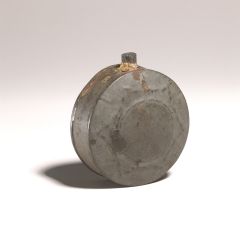
c. 1853
The British Museum
London, United Kingdom
Good health and, indeed, life itself is impossible without water. Every traveller, whether journeying alone or in a convoy or caravan, had to ensure that water was readily available. In the often-challenging climatic and geographic conditions of the Middle East and North Africa, access to fresh water could regularly pose a serious challenge.
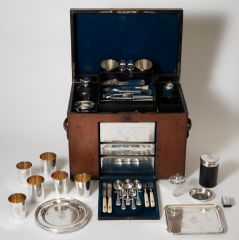
c. 1860
Ajuda National Palace
Lisbon, Portugal
Travel cases like this one would have been among the essential equipment carried by European upper-class travellers in the 19th century. While undoubtedly attracted by the “authentic” as much as the romantic aspects of travel across the “Orient”, these travellers, nevertheless, were not prepared to surrender certain comforts that they were used to enjoying at home.

A bedouin and his camel/dromedary
c. 1870
National Library of France
Paris, France
Many European explorers and adventurers relied on Bedouin expertise to cross uncharted desert landscapes, even if sometimes they claimed later that they had undertaken the journey and “discovered” new lands entirely on their own. Indeed, rarely do these 19th-century travellers acknowledge the extensive and often essential support of their local guides.

c. 1880–1900
Pharmacy Museum
Lisbon, Portugal
While travelling to non-European territories, it was considered mandatory to have a personal portable pharmacy kit at hand. This case carried myriad medicines aimed at protecting its owner from the most common diseases one could encounter while abroad.

1885
National Museum of Decorative Arts
Madrid, Spain
The legendary and romantic sites associated with Southern Spain’s Arab–Islamic legacy were widely known across Europe, mainly from the many publications that ranged from the exquisitely detailed artistic studies of the British artist Owen Jones to the fabled stories of the Alhambra by Washington Irving. Large numbers of wealthy tourists flocked to the region with their guide books and related publications close to hand.
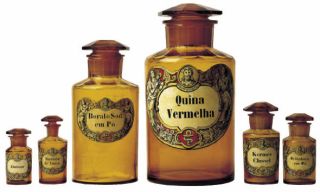
c. 1890–1910
Pharmacy Museum
Lisbon, Portugal
These bottles were used as containers for Cinchona (quina) bark, which was believed to prevent foreign diseases such as fevers and, notably, malaria, as it contains the alkaloid quinine. The bottles were used by Europeans travelling to non-European territories that were often unknown to the European community; hence precaution was mandatory in order to ensure safe and healthy expeditions.
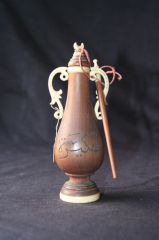
1895
Musée Public National des Antiquités
Algiers, Algeria
Europeans were not alone in their pursuit of remedies. In many parts of the Arab and Islamic world, locals relied on natural remedies and prophylactic treatments. For example, Kohl has always been popular in the region as an ointment to protect the eyes.