

 Close
Collections | Reforms and Social Changes | Women | Struggle for women's rights [17 Objects]

The Artist Girl and Her Studio
19th century
Sabancı University, Sakıp Sabancı Museum
Istanbul, Türkiye
 See Database Entry
It was difficult for women to access certain artistic professions both in Europe and in the Arab and Ottoman world. In the late 19th century, women slowly began to come into their own in the world of painters, sculptors and writers.
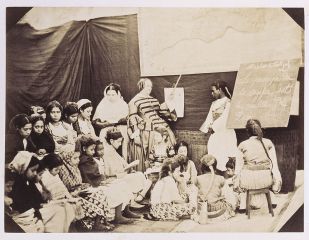
School of North African girls directed by Mme Luce. Studying
1856–1857
National Library of France
Paris, France
The French government hesitated over ruling on education for young Muslim girls, which was a delicate subject. Consequently, the first related initiative was a private one, and the teaching provided was essentially professional in nature.
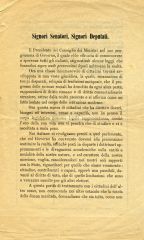
1877
State Library of Modern and Contemporary History
Rome, Italy
In Europe, women’s access to political life ignited impassioned debates throughout the 19th and early 20th centuries. The right to vote was one of the major battles in the fight for male/female equality.

Late 19th century – early 20th century
'Zahrat al-Ihsan School ('The Flower of Beneficence' School)
Beirut , Lebanon
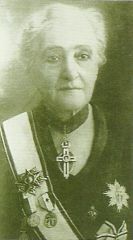
In the 19th century the debate about women’s role in society and their education developed in both Europe and the Arab and Ottoman world. This portrait of a founder of Zahrat al-Ihsan School, Beirut, reminds us of the increasingly public role prominent women throughout the Middle East played from the 19th century onwards. The charitable school provided education for disadvantaged girls.
Late 19th century – early 20th century
Zahrat al-Ihsan School ('The Flower of Beneficence' School)
Beirut , Lebanon
In the 19th century the debate about women’s role in society and their education developed in both Europe and the Arab and Ottoman world. This portrait of a founder of Zahral al-Ihsan School, Beirut, reminds us of the increasingly public role prominent women throughout the Middle East played from the 19th century onwards. The charitable school provided education for disadvantaged girls.

Unknown (probably end of the 19th–beginning of the 20th century)
State Archives of Cremona
Cremona, Italy
In Europe in the 19th and early 20th centuries, women gradually began to emerge from the domestic environment to obtain the same social rights as men.

1898
Victoria and Albert Museum
London, United Kingdom
Women were also demanding access to the same leisure and sports activities as men in 19th century Europe. Women quickly began using bicycles, first as a leisure activity for the wealthier classes, then as a means of transport for more modest people.
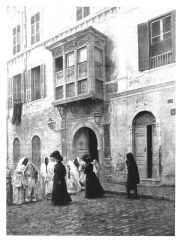
L'École de la Rue du Pacha (classrooom exit)
1907
Institut Supérieur d’Histoire Contemporaine de la Tunisie
La Manouba, Tunis, Tunisia
Access to modern education was essential for women in the Arab and Ottoman world at the beginning of the 20th century. In countries such as Tunisia the struggle for independence enabled women to participate in political rallies from which they had previously been excluded.

3 September 1906
State Archives of Perugia
Perugia, Italy
In the Arab and Ottoman world in the early 20th century, women began participating in political rallies from which they had previously been excluded.
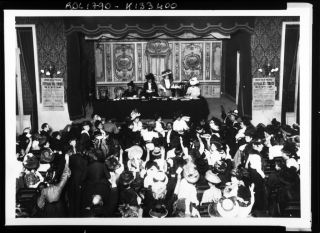
General meeting on women's suffrage
1908
National Library of France
Paris, France
In Europe, women’s access to political life ignited impassioned debates throughout the 19th and early 20th centuries. The right to vote was one of the major battles in the fight for male/female equality.

1910 (designed and printed)
Victoria and Albert Museum
London, United Kingdom
In Europe, women’s access to political life ignited impassioned debates throughout the 19th century and in the early 20th century. The right to vote was one of the major battles in the fight for male/female equality.
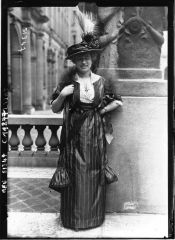
Mlle. Lauta, first [French] woman to get a degree in philosophy
1914
National Library of France
Paris, France
In Europe, giving young girls the rights to the same education as boys was a long fight, which lasted throughout the 19th century.
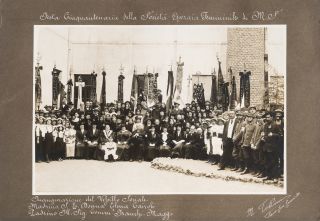
1914
State Archives of Cremona
Cremona, Italy
In Europe in the 19th and early 20th centuries, women gradually began to emerge from the domestic environment to obtain the same social rights as men.

c.1914 (issued)
Victoria and Albert Museum
London, United Kingdom
In Europe, women’s access to political life ignited impassioned debates throughout the 19th century and in the early 20th century. The right to vote was one of the major battles in the fight for male/female equality.
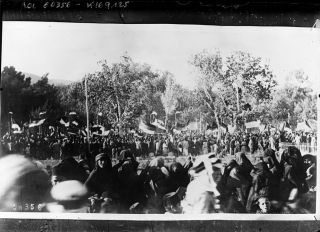
The Syrian independence movement; a crowd protesting in the streets of Damascus
1920
National Library of France
Paris, France
In the Arab and Ottoman world, the struggle for independence enabled women to participate in political rallies from which they had previously been excluded.

Women in the Revolution of 1919
March 1919
Bibliotheca Alexandrina
Alexandria, Egypt
In the Arab and Ottoman world, the struggle for independence enabled women to participate in political rallies from which they had previously been excluded.

An Egyptian woman giving a public speech during the events of the 1919 Revolution
March 1919
Bibliotheca Alexandrina
Alexandria, Egypt
In the Arab and Ottoman world, the struggle for independence enabled women to participate in political rallies from which they had previously been excluded.